Research focus
I build multiscale simulations and learning tools for reacting and multiphase flows. My work links reactive molecular dynamics, which shows how soot particles form and grow, with continuum CFD of sprays and flames, and with machine-learning tools that read structure back out of simulations and microscope images.
Current work
Electrochemical and plasma-assisted reacting flows
Computational Reactive Flow & Energy Lab (CRFEL), Dr. Suo Yang, University of Minnesota
I develop OpenFOAM-based solvers for charged, reacting transport in electrolytes. The models couple multi-species Poisson–Nernst–Planck transport with homogeneous chemistry, electrode kinetics, electrical double layers, flow with electro-osmotic effects, and gas–liquid interfaces. The work builds on my background in reacting-flow CFD and molecular simulation.
- 01
Soot inception and morphology
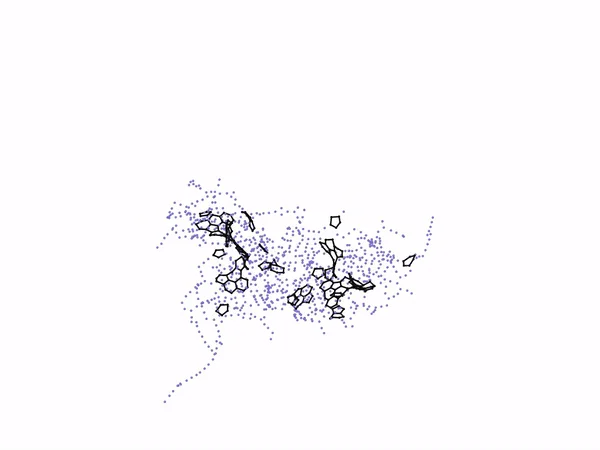
Using reactive molecular dynamics (RMD) of acetylene pyrolysis, I follow soot from precursor molecules to incipient particles and resolve how their internal structure, pores and surfaces evolve. This is the subject of my Ph.D. dissertation and of papers in Carbon, Fuel, The Journal of Physical Chemistry A and Aerosol Research.
- 02
Spray combustion and pollutants
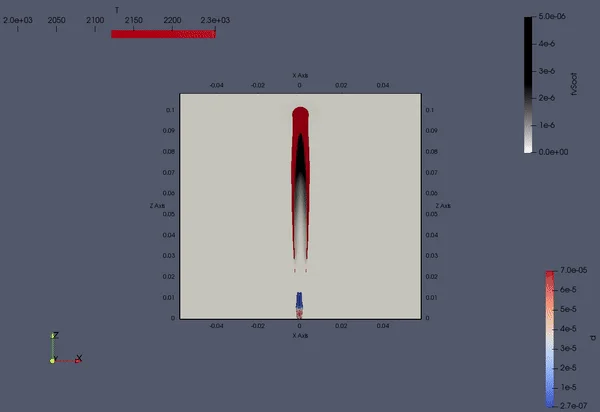
CFD of high-pressure spray combustion in the ECN Spray-A configuration, examining how ambient oxygen, exhaust gas recirculation (EGR) and multiphase radiation affect soot and NOₓ formation (Combustion Theory and Modelling; M.S. thesis).
- 03
Machine learning for soot imaging
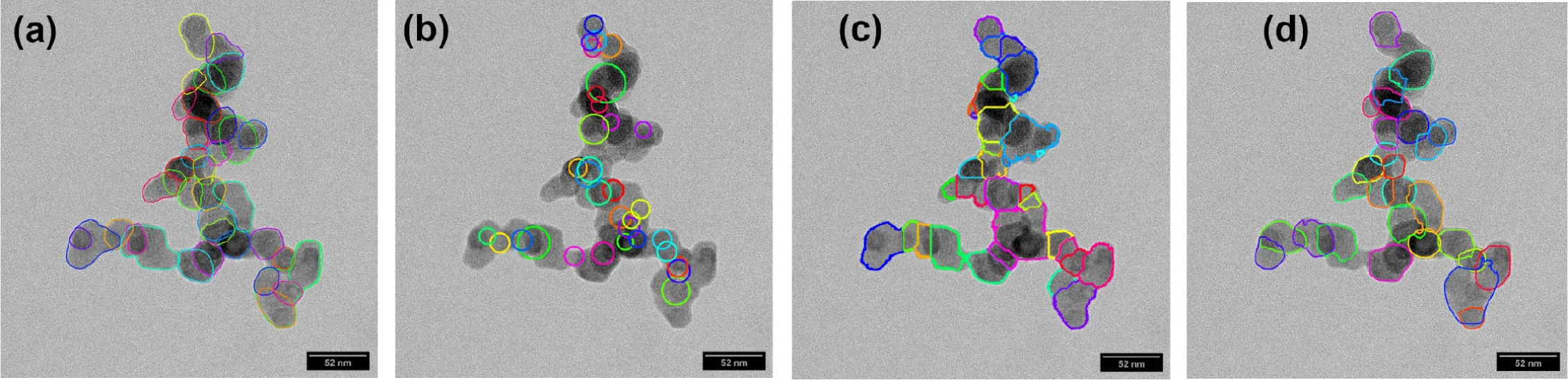
SAGE (Soot Aggregate Geometry Extraction) is a machine-learning model that segments primary particles in TEM images of soot aggregates (Proceedings of the Combustion Institute).
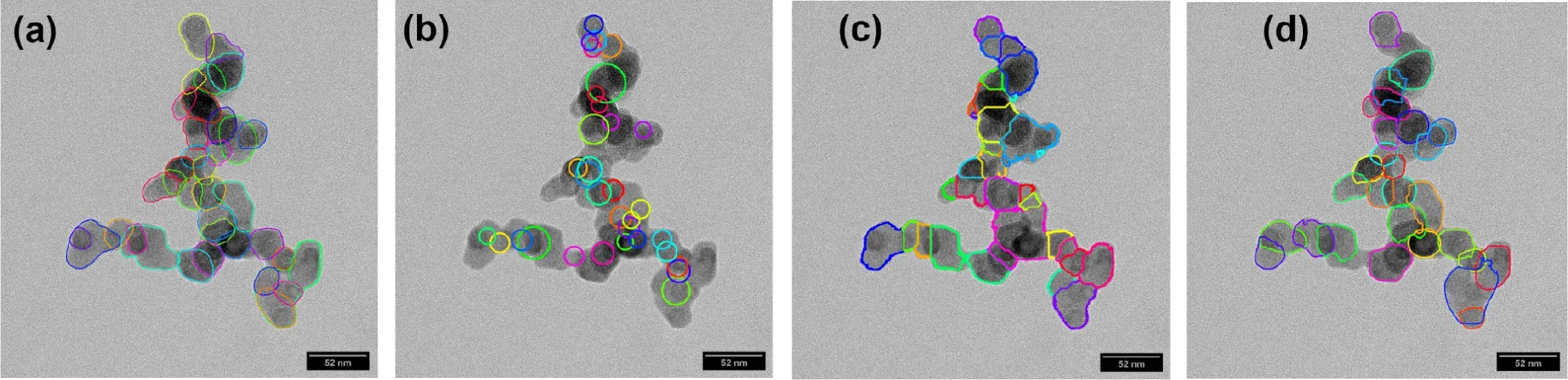
Primary particles in a sample aggregate from the test set predicted by each segmentation method: (a) manually segmented (ground truth), (b) circular Hough transform, (c) Euclidean distance mapping–watershed, and (d) current SAGE2 model. From Day et al., Proc. Combust. Inst. 41 (2025), Fig. 3. - 04
Open research software
I release the tools behind my work. MAFIA-MD analyzes ring and fringe structures from reactive MD (Computer Physics Communications), PyPack builds molecular systems for LAMMPS, and StereoFractAnalyzer measures fractal dimensions of surfaces and images.
- 05
Thin-film phase change
Molecular dynamics of thin-film argon evaporation and boiling over flat and nanostructured surfaces under different wetting conditions, and of bubble nucleation in confined liquids.
- 06
Large-scale CFD on HPC
High-fidelity CFD of microclimate at the city-block scale, and a framework for optimizing load balancing in large-scale Lagrangian–Eulerian simulations on HPC systems.